Can Filling Line
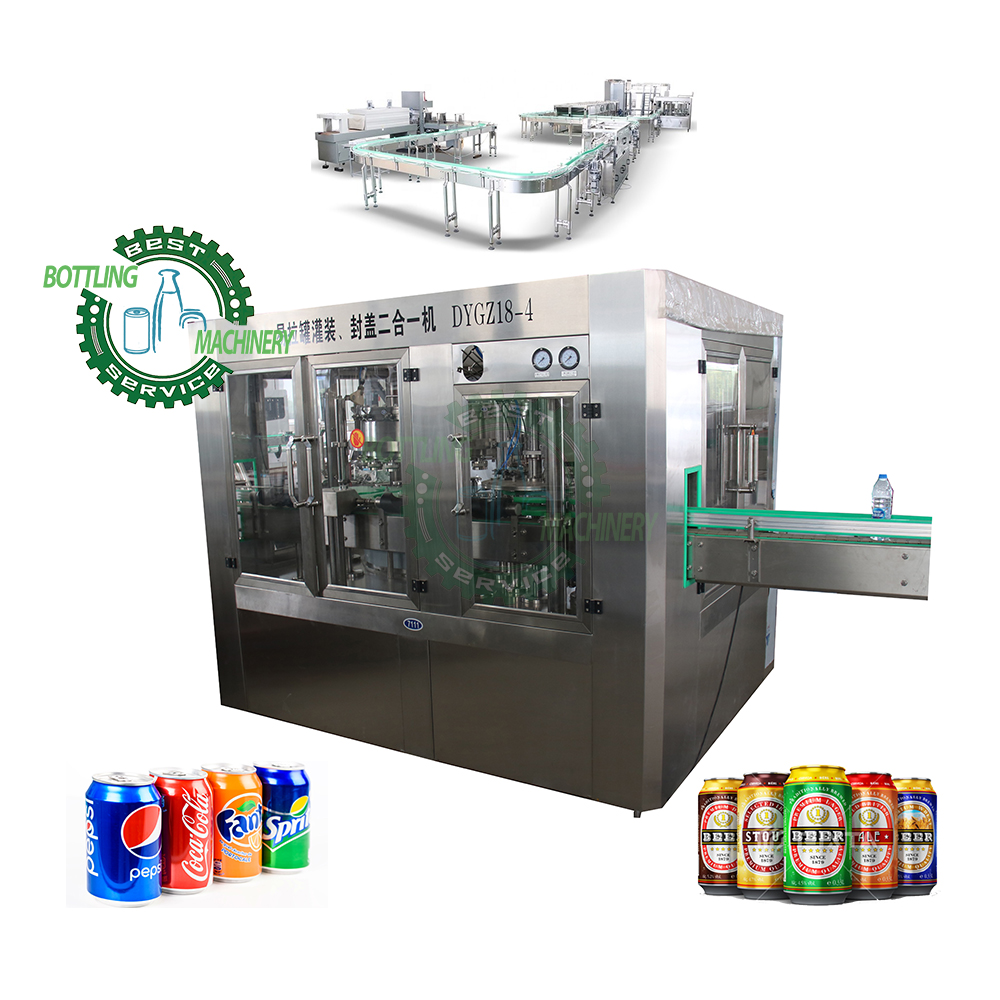
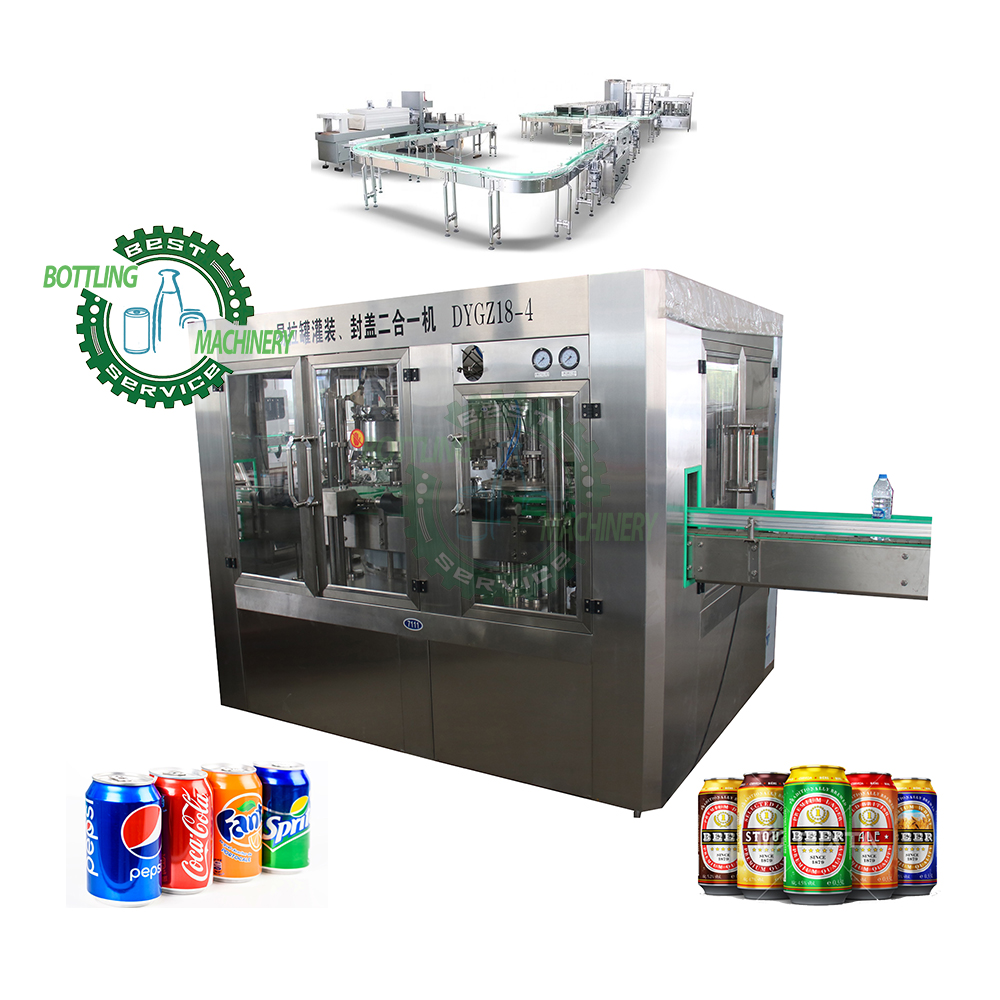 | Tin PET aluminum can production and filling lineWe provide automatic canning machines and complete canning lines for food and beverage applications. Suitable for tin and aluminum cans, our equipment supports beer, soda, soft drinks, water, and food products, offering efficient, reliable, and cost-effective canning solutions. |
Complete A-to-Z Can Filling Production Line
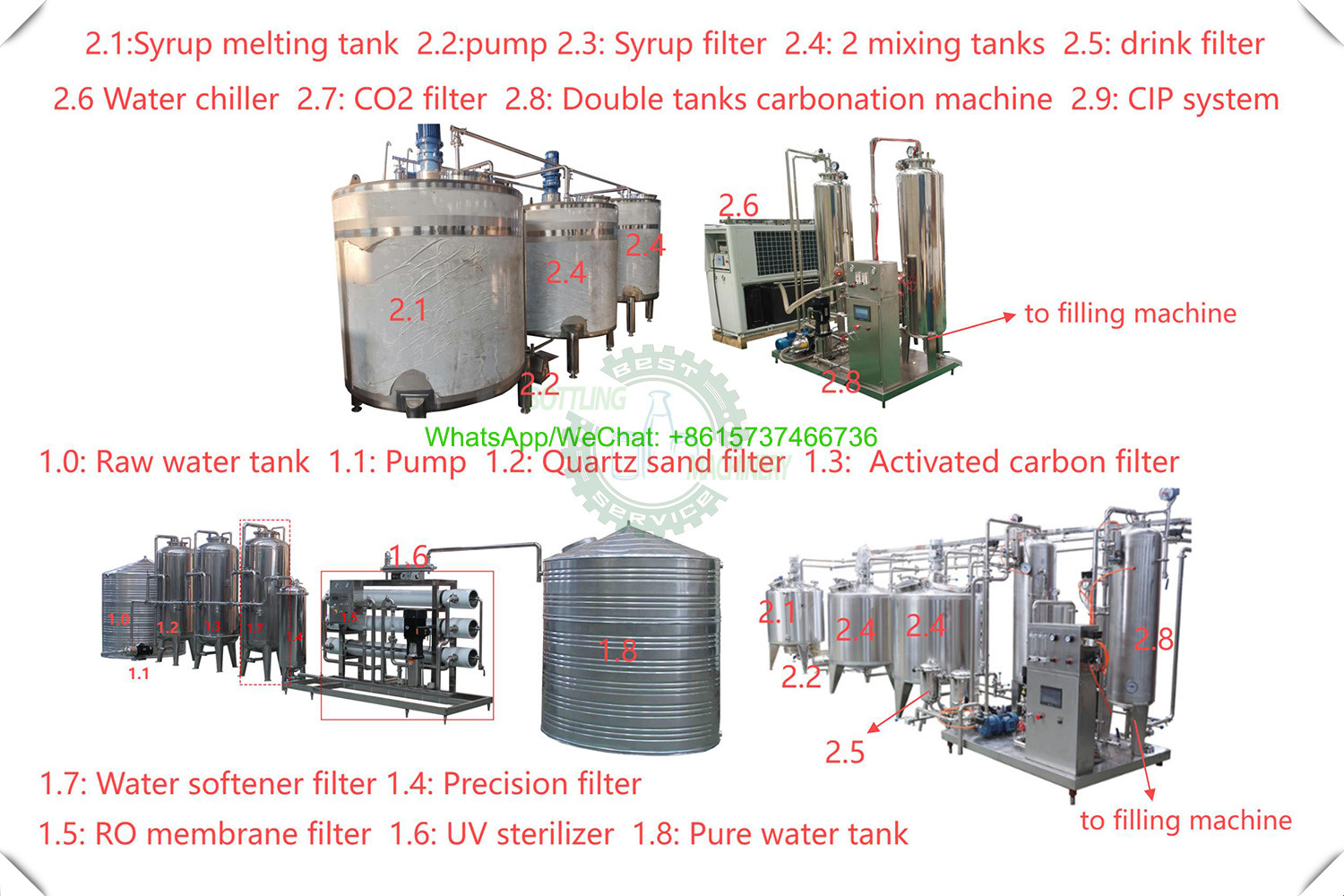
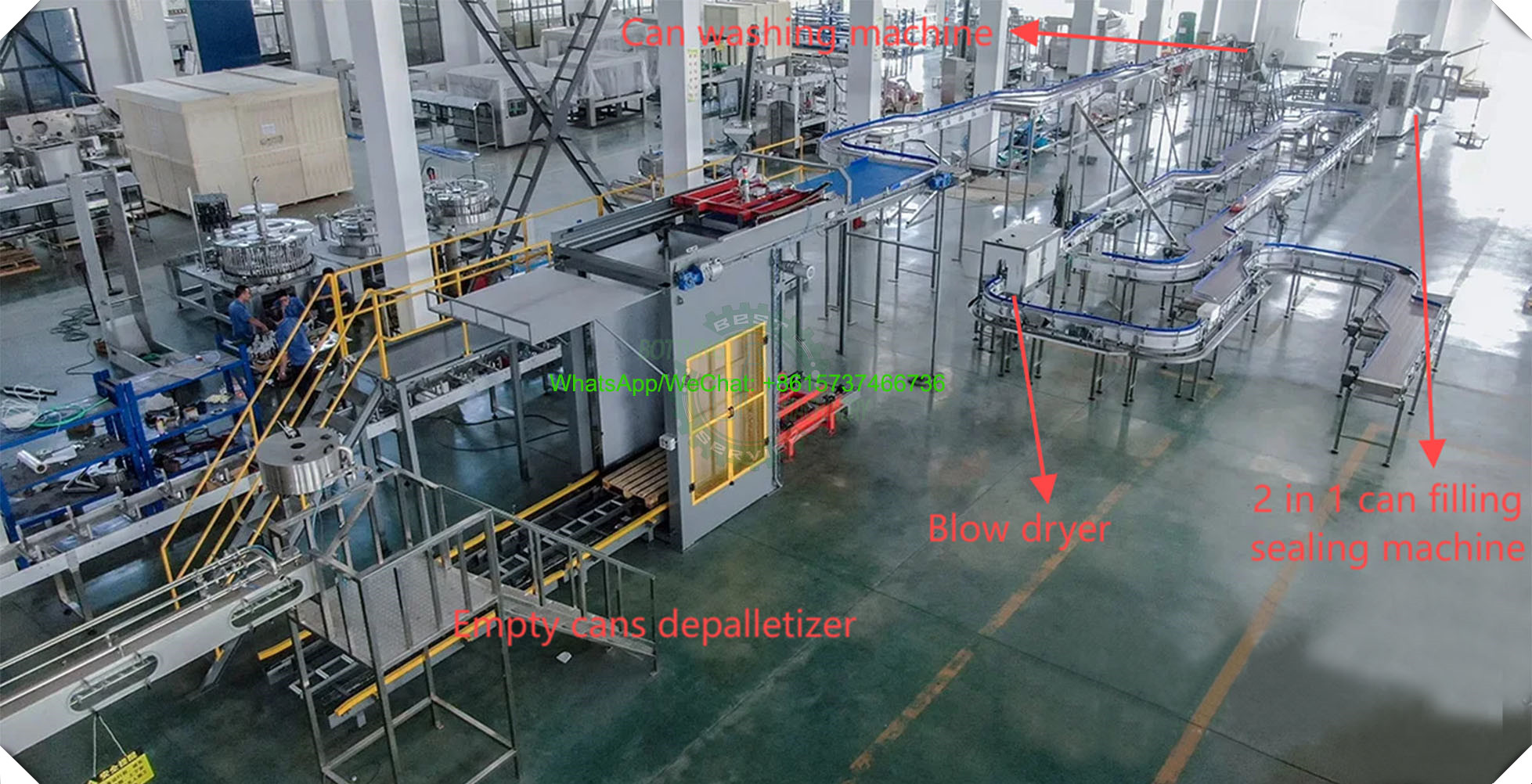
Our integrated can filling line provides a comprehensive solution from beverage preparation to final packaged cans. The system includes a beverage processing section, water treatment system, automatic can making machine, empty can depalletizer, can washer, 2-in-1 filling and sealing machine, hot water spray warming tunnel, can labeling machine, and a film shrink wrapping machine or carton packing system.
What type of beverage do you plan to fill?
Carbonated drinks? Beer? Juice? Energy drinks? Iced tea? Coffee? Or alcoholic beverages?
We customize the beverage preparation system to match your product:
For carbonated/soft drinks: The system includes a syrup melting tank, cooling tank, mixing tank, filter, CO2 filter, water chiller, carbonator, and CIP system.
For juices and similar products: The line is equipped with a syrup melting tank, juice mixing tank, double filter, homogenizer, vacuum degasser, UHT juice sterilizer, aseptic tank, and more.
We supply the complete beverage processing system tailored specifically to the liquid you intend to produce.
Please check the video of can filling line: https://youtu.be/WqOtdb0xiRg
Can Filling and Packaging Line: Key Considerations
Cans are classified by material into aluminum cans, PET cans, and tinplate cans. In terms of shape, common categories include slim, sleek, standard, and stubby.
An important prerequisite for efficient filling is that the aluminum cans you select must share the same diameter, meaning all lids must be identical in size. Otherwise, they cannot be used interchangeably on the same filling machine.
Furthermore, please consider: Are your empty cans pre-printed (already painted) or do they require sleeve shrink labeling? If they are blank, you will need a sleeve labeling machine to apply and heat-shrink labels onto the cans.
If your cans are made of PET material, you may require the following two additional machines.
Please check the video of can cutting machine 3500cph: https://youtu.be/pct_qlB7ioA
Automatic PET Can Making Machine
(Includes Bottle Blow Molding Machine and Bottle Neck Cutting Machine for PET Can Production)
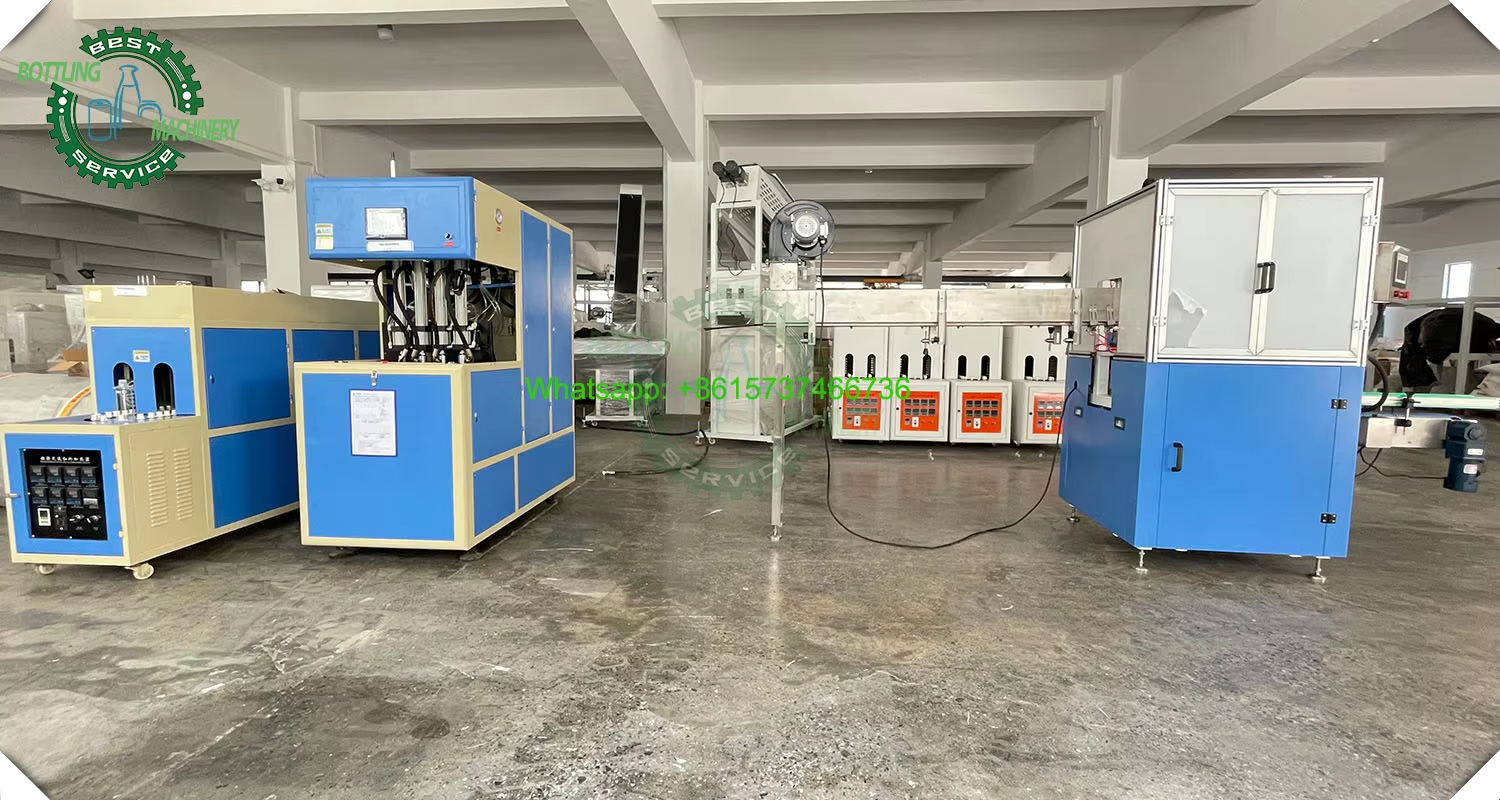
There are two methods for producing PET cans using the Automatic PET Can Making Machine, which consists of a bottle blow molding machine and a bottle neck cutting machine.
1. Direct Blow Molding Method with PET Can Blow Molding Machine
This method requires dedicated can preforms. The main consideration is that this blow molding machine has a single function and is designed specifically for producing cans, not bottles.
2. Two-Step Production Method with PET Bottle Blow Molding Machine and Can Cutting Machine
In this method, a PET bottle blow molding machine first forms preforms into complete bottles. Subsequently, a cutting machine removes the upper portion of these bottles to create finished PET cans. The blow molding machine requires a specially designed mold for this process (as illustrated above). The automatic blow molding machine can be connected to the cutting machine via air conveyor. A key advantage of this approach is that the same blow molding machine can also produce various types of bottles simply by changing the mold.
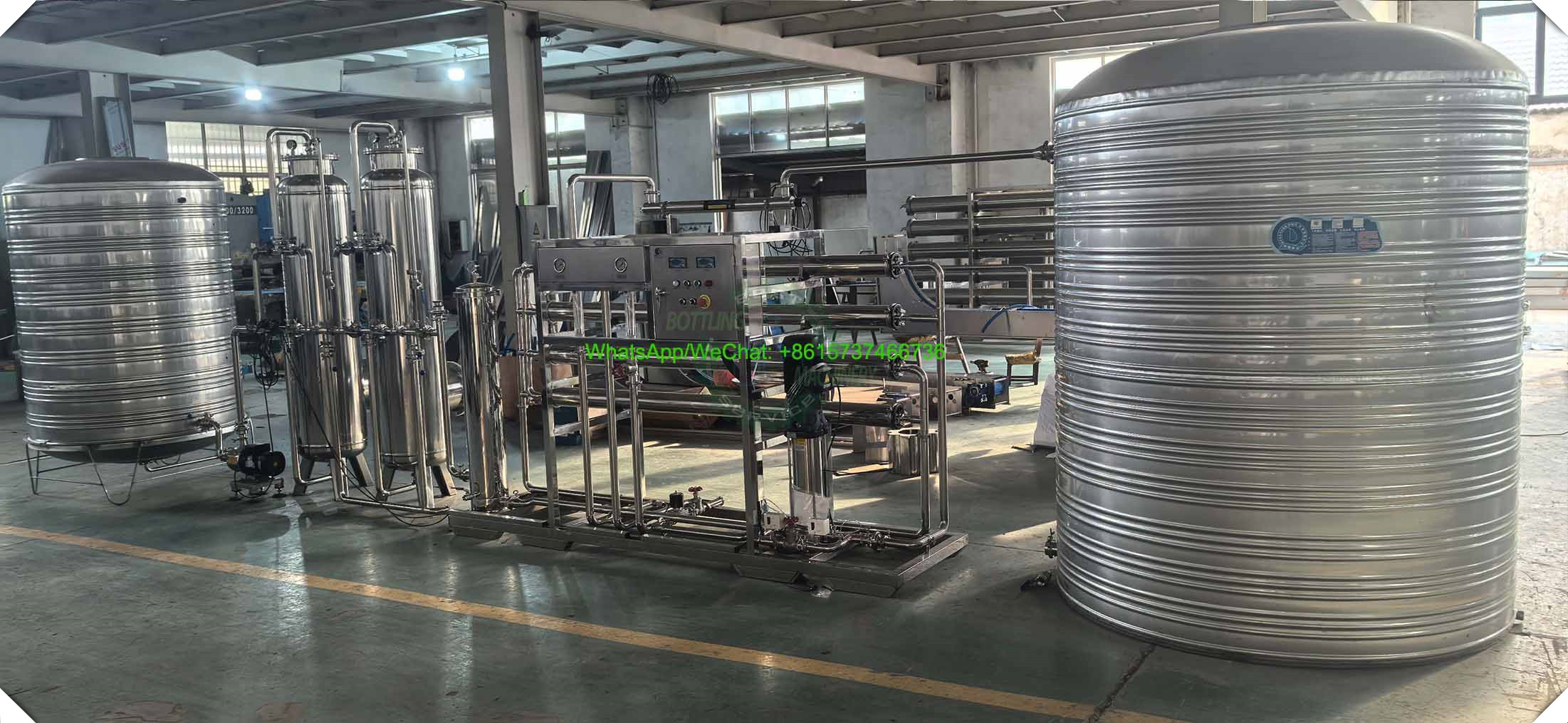
Categories: Water treatment systems include RO (Reverse Osmosis) systems, UF (Ultrafiltration) systems, DRO (Dual Reverse Osmosis) systems, RO combined with EDI (Electrodialysis) units, RO combined with electrolysis units for producing weakly alkaline water, and seawater desalination systems. For standard bottled water filling lines, Reverse Osmosis (RO) systems are most commonly installed.
Working Principle of Reverse Osmosis: The system applies high pressure to force water through a semi-permeable membrane, effectively removing dissolved salts, organic matter, bacteria, and viruses to produce high-purity water.
System Components: The complete setup consists of a raw water tank, quartz sand filter, activated carbon filter, water softener, precision filter, reverse osmosis membrane module, UV sterilizer, ozone generator, ozone mixing tower, and a pure water storage tank.
Production Capacity: Our machines are available in a wide range of capacities to suit various production needs: 250 L/H, 500 L/H, 1,000 L/H, 2,000 L/H, 3,000 L/H, 5,000 L/H, 8,000 L/H, 10 T/H, 20 T/H, 30 T/H, 50 T/H, and 100 T/H.
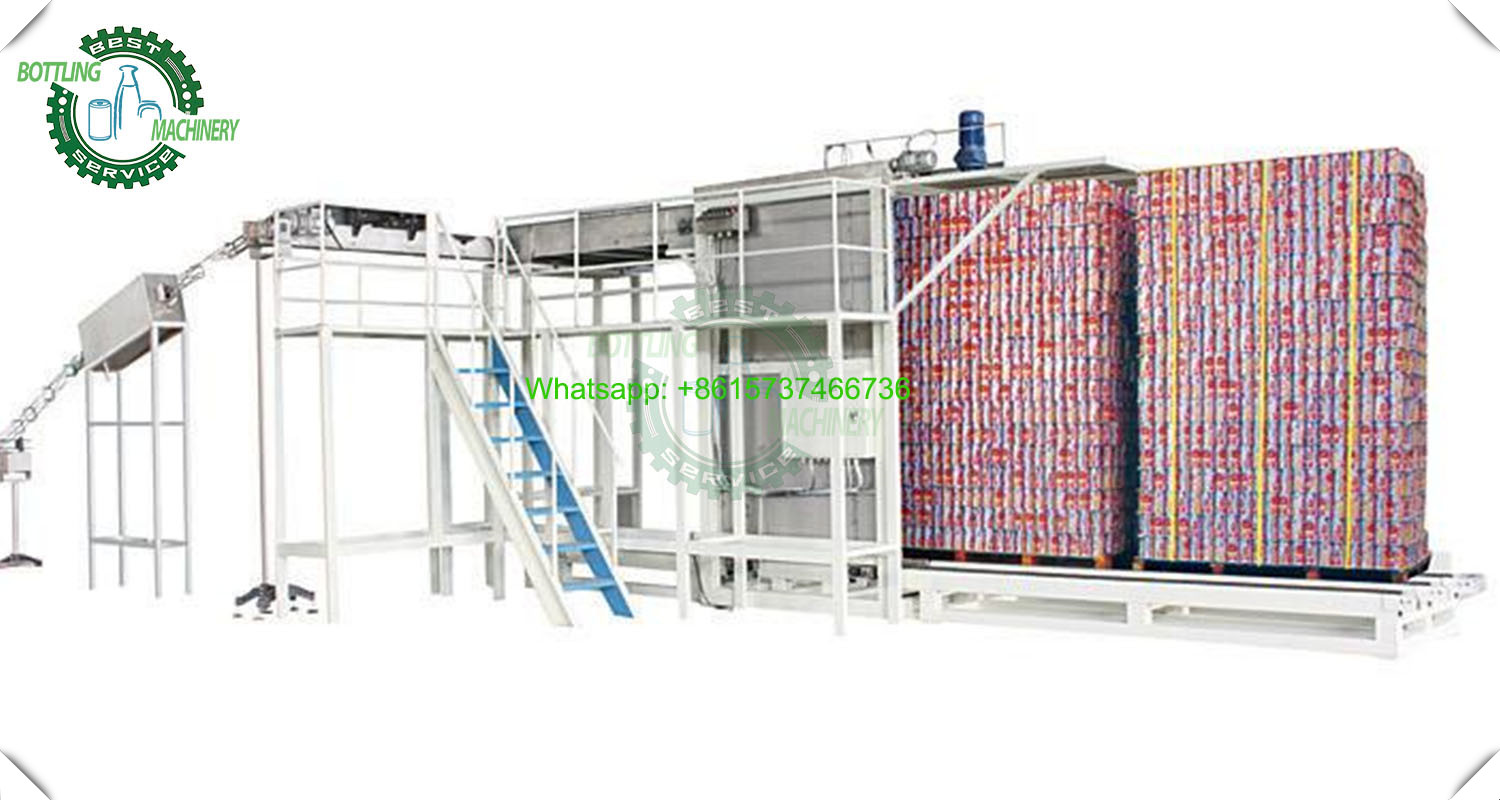
Please check the video of Empty cans depalletizer unloading unstacking machine: https://youtu.be/Nnwuifh1Jpo
Empty Can Depalletizer
I. Working Principle
Pallet Positioning: The stacked pallet of empty cans (typically on plastic or cardboard bases) is automatically conveyed and positioned at the unloading station.
Layered Unloading: A set of vacuum suction cups or mechanical grippers lifts the entire layer of cans from the top of the stack, unloading them layer by layer (typically 20–40 cans per layer, depending on the pallet layout).
Single-File Separation: The layer of cans is then singulated into a single-file stream via a vibrating or centrifugal can separator and transferred onto the conveyor belt.
Quality Inspection: Photoelectric sensors detect and automatically reject any cans that are inverted, deformed, or contain foreign objects.
II. Core Features
High Speed & Efficiency: Unloading speeds of 1,500–3,000 cans per minute (depending on can diameter and stack height) support continuous production.
Intelligent Adaptability: Compatible with various can diameters (e.g., 200ml–500ml), heights, and pallet specifications through adjustable touch-screen parameters.
Low-Loss Design: Features food-grade silicone vacuum cups to prevent scratching and integrated buffer mechanisms to minimize denting and deformation.
Modular Structure: Designed for quick changeover; switching can types requires only changing the gripper/suction cup module, with a total changeover time of under 15 minutes.
Energy Efficient: Utilizes servo motor drives, consuming approximately 30% less energy than traditional pneumatic systems.
III. Application Scenarios
Beverage Production Lines: Unloading empty cans (for cola, beer, energy drinks, etc.) prior to the filling process.
Can Manufacturing Facilities: Re-stacking or boxing empty cans after quality inspection.
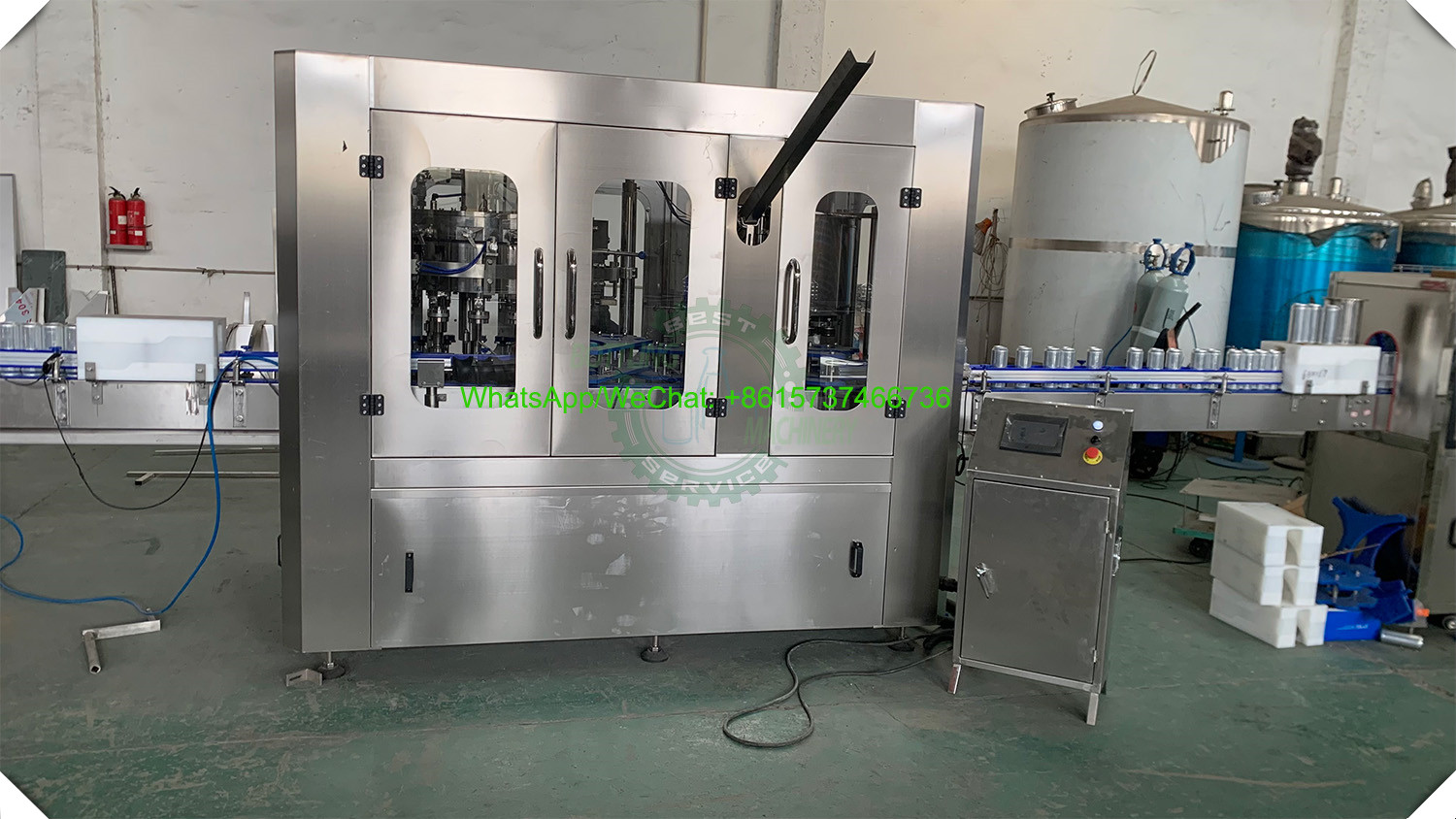
2-in-1 Can Filling & Seaming Machine
A can washing tunnel is positioned between the depalletizer and the filling machine. After orientation, the cans enter this tunnel where they are inverted and the interior is cleaned with water or air before proceeding to the filling station.
I. Core Classification and Principle Comparison
| Type | Carbonated Beverage Filling Machine (e.g., Carbonated Drinks/Beer) | Non-Carbonated Beverage Filling Machine (e.g., Juice/Iced Tea/Functional Drinks) |
|---|---|---|
| Filling Principle | Isobaric Filling: 1. Inject CO₂ to equalize pressure with the liquid tank. 2. Liquid flows smoothly by gravity to prevent foaming. | Negative-Pressure/Atmospheric Filling: 1. Evacuate air from the can (negative-pressure) or fill openly (atmospheric). 2. Liquid level sensor controls volume with ±1ml accuracy. |
| Can Sealing Method | High-speed double-seaming under pressure to ensure airtight seal. | Standard seaming or easy-open end sealing (lower airtightness requirement). |
| Applicable Beverages | Drinks containing CO₂: cola, beer, sparkling water, soda. | Non-carbonated drinks: juice, iced tea, plant-based protein drinks, energy drinks. |
Working Principle:
CO₂ Pre-charge: CO₂ is injected into the empty can to displace air and create pressure balance with the liquid tank (typically 0.8–1.2 bar).
Isobaric Filling: Liquid flows into the can without pressure differential; level is controlled by a mechanical float or flow meter.
Pressure Relief & Gas Return: Residual gas is vented prior to sealing to prevent splash upon opening.
High-Speed Seaming: The seamer instantly completes the crimp and seal (≤0.5 seconds per can) to ensure airtight integrity.
III. Non-Carbonated Beverage Filling Machine (e.g., Juice/Iced Tea)
Working Principle:
Sterilization Pretreatment: UHT-sterilized beverage is cooled to 25–30°C before entering the aseptic filling system.
Negative-Pressure Filling: Air is evacuated from the can (approx. -0.8 bar) to minimize oxidation.
Hot Filling (Optional): Beverage can be filled at high temperature (85–93°C), using residual heat for can sterilization.
Seaming & Coding: After standard seaming, the production date is applied via laser printing.
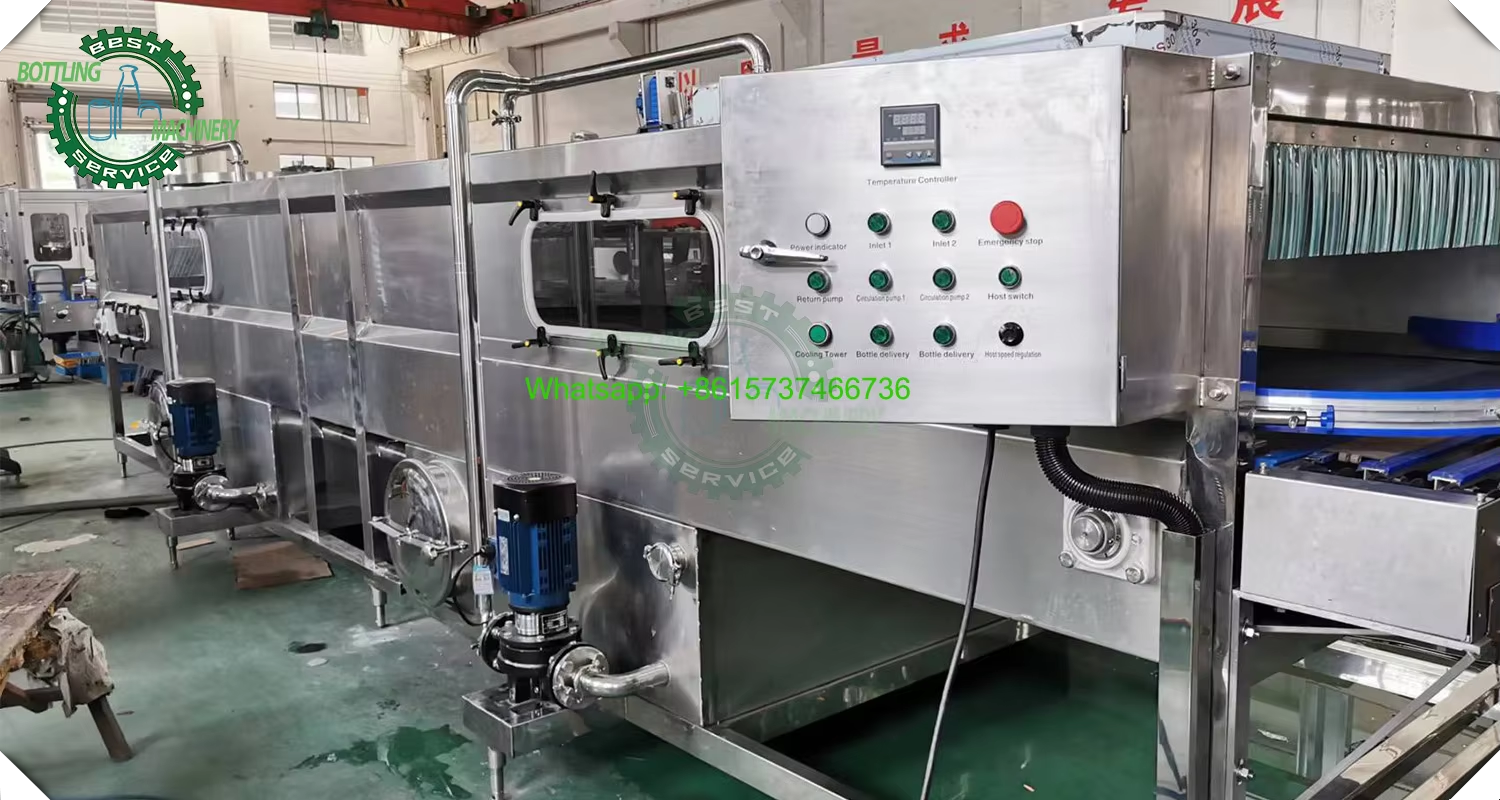
The Can Warming Tunnel, also known as a tunnel pasteurizer, is used to address condensation. When cans filled with beverages at approximately 4°C encounter ambient air, significant condensation forms on the exterior, which is unsuitable for subsequent labeling and coding. This machine gently heats the cans, dries them, and prepares them for labeling and coding by raising their surface temperature to room temperature (typically 30-35°C).
It operates as a tunnel-style spray system, heating cans through heat exchange from circulating hot water sprays. The machine is primarily composed of a frame, conveyor chain, drive system, water storage tank, circulation pump, spray device, heating unit, and pipeline network.
Available Configurations:
1.Standard Can Warmer (without sterilization section): For direct heating and condensation control.
2.Pasteurizer (with sterilization section): Provides a complete heating, holding, and cooling process for product stabilization.
The pasteurizer with a sterilization section employs a four-stage sequence: preheating → sterilization → pre-cooling → final cooling, with top-to-bottom spray coverage. The sterilization temperature and time (e.g., 65-75°C for 10-15 minutes for beer) are fully adjustable, automatically controlled, maintained, and recorded.
Application Guidance:
Carbonated Beverages: Typically use the standard can warmer (without sterilization section).
Beer: Often requires the pasteurizer model (with sterilization section) to ensure product stability and extended shelf life.
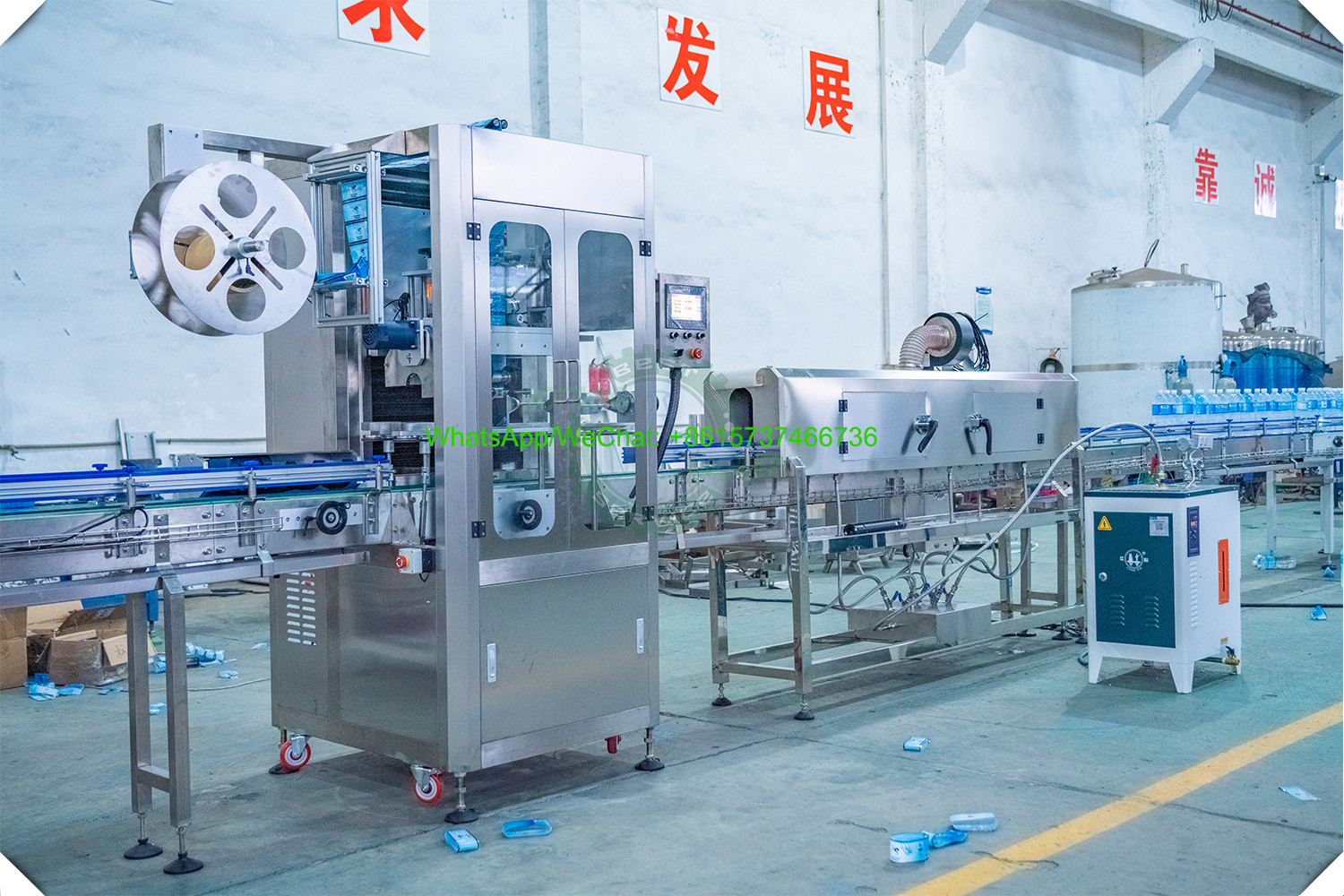
Please check the video of automatic sleeve shrink labeling machine: https://youtu.be/OF9g_sU5Yww
Sleeve Labeling Machine
If your cans are not pre-printed, a sleeve labeling machine is required. Please note that if you purchase printed cans in China, the typical minimum order quantity is 500,000 units.
The complete sleeve labeling system consists of a sleeve labeling unit, a steam shrinking tunnel, and a steam generator.
The labeling unit cuts and applies the sleeve label onto the can. The steam tunnel heats water to generate steam, which is then distributed evenly throughout the tunnel via a pipe system. Upon contact with the high-temperature steam, the label shrinks tightly and conforms to the can. As condensation often forms on labels after shrinking, we recommend adding a blow dryer after the tunnel for optimal results.
This machine is adaptable to various container sizes. Please note that change parts for different sizes are available at an additional cost.
We also offer a double-head sleeve labeling machine, which integrates two labeling stations in one unit—one for applying the body label and another for a cap label.
The steam generated by the shrinking tunnel may increase humidity within the production area. We recommend connecting an exhaust pipe to vent steam outdoors. If you prefer to avoid the steam method, we also provide electric heating shrinking tunnels. However, electric heating may result in less uniform heat distribution, leading to inconsistent shrinking in some areas. To improve results with electric heating, we can customize a dual-speed conveyor line where containers rotate as they travel, promoting even shrinkage. Nevertheless, we generally recommend the steam shrinking method for the most consistent and reliable finish.
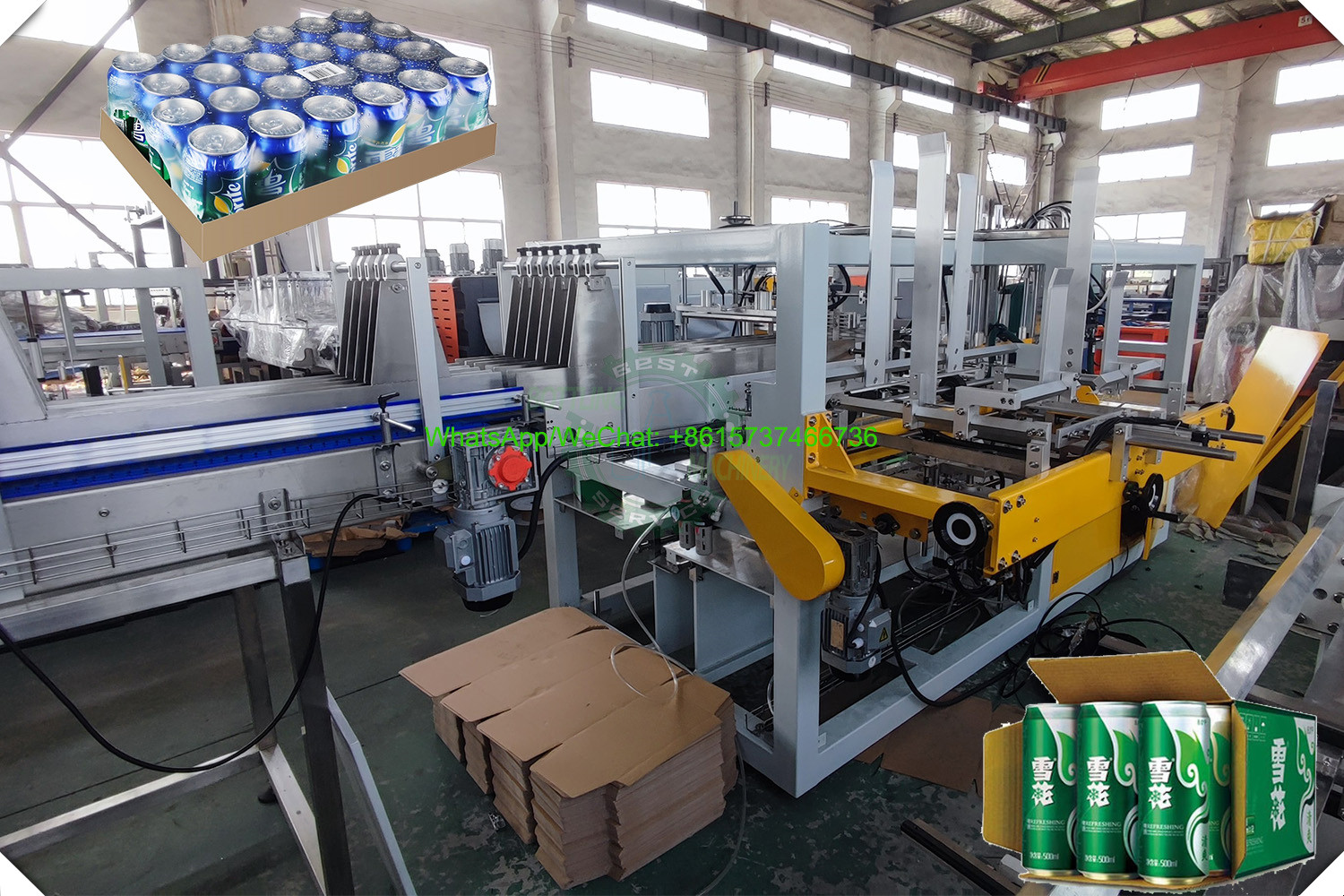
Please look over the video for automatic beer can carton packing machine cardboard folding glue sealing: https://youtu.be/4F2Cy0tnVDk
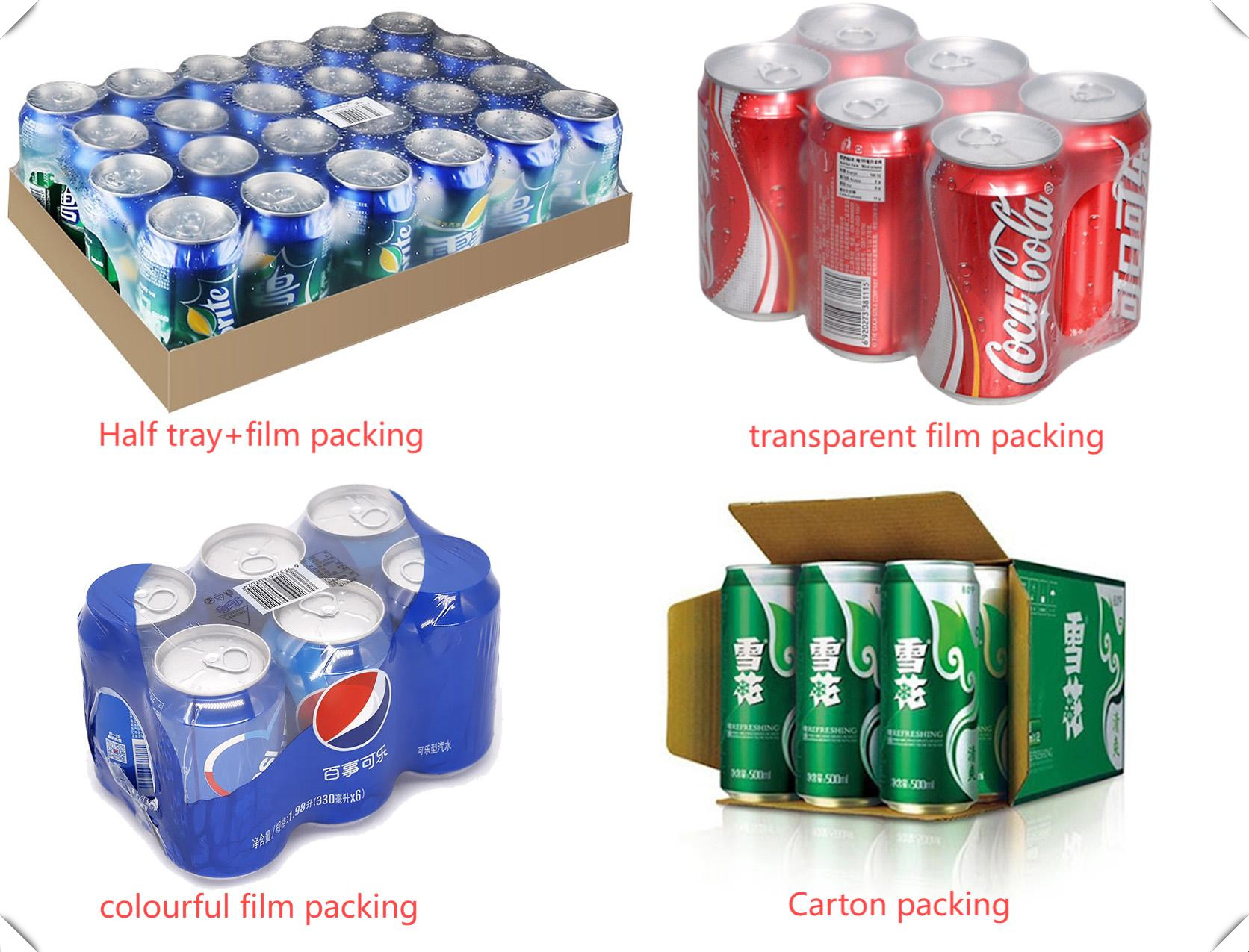
Can packaging primarily includes Half Tray + Film Packing, Transparent Film Packing, Colored/Printed Film Packing, and Carton Packing. Which format do you require? Each option corresponds to a different machine.
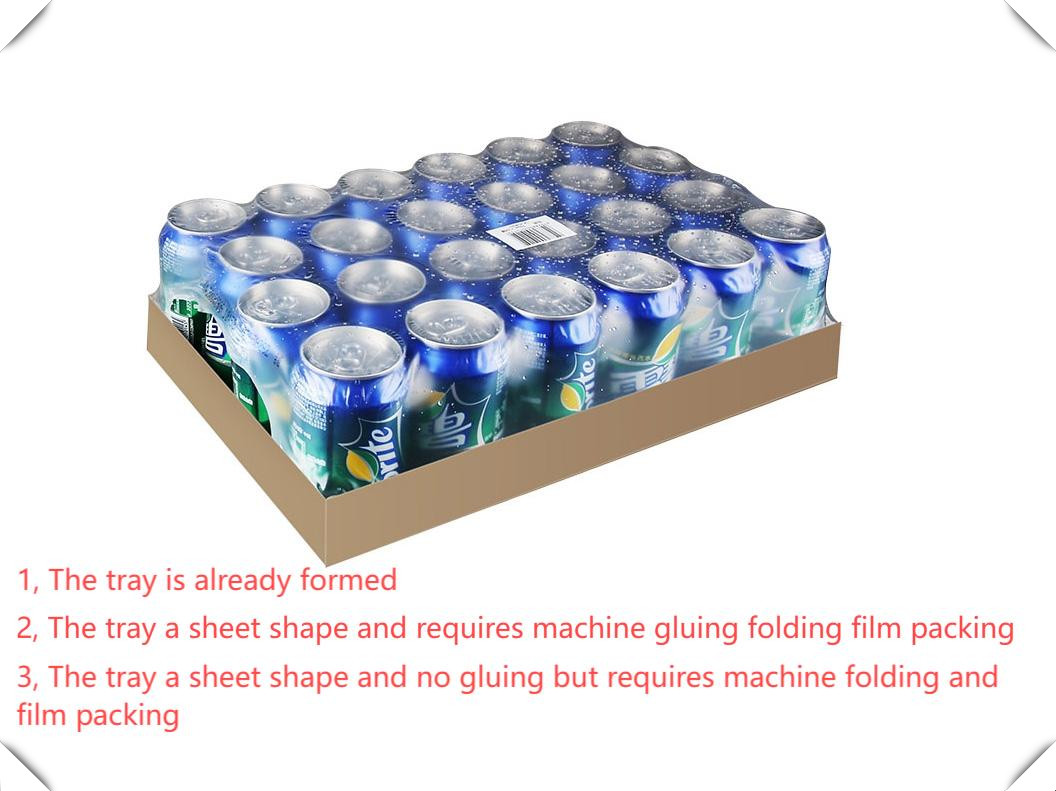
If your packaging involves a half tray, please note that trays come in three forms, each requiring specific equipment:
Pre-formed Trays: The tray is already shaped and ready for use.
Flat Sheets (with glue): The tray is supplied as a flat sheet, and the machine applies glue, folds it into shape, and then applies the film.
Flat Sheets (glue-less): The tray is supplied as a flat sheet, and the machine folds it (without glue) before film packing.
Which form does your half tray take? Each type corresponds to a different machine.
Approximate Price Guide (for reference):
Machine for Pre-formed Trays (Semi-Automatic): $2,500 – $5,000 USD
Machine for Flat Sheet Trays with Glue + Film Packing: $60,000 – $70,000 USD
Transparent Film Packing Machine: $2,500 – $25,000 USD
Colored/Printed Film Packing Machine: $30,000 – $50,000 USD
Carton Packing Machine: $20,000 – $50,000 USD
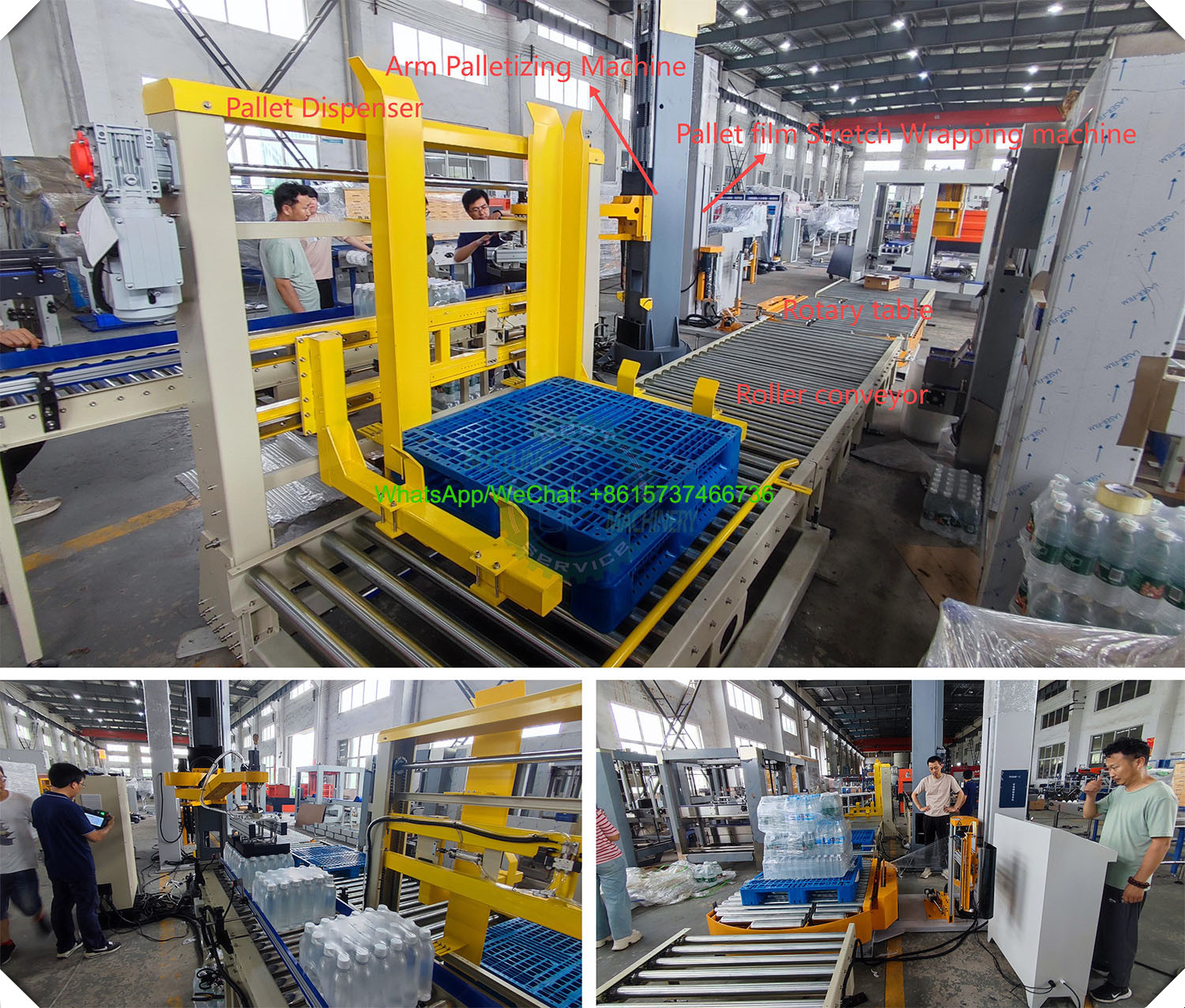
Palletizer Equipment, Stacking Pallet Provider, and Pallet Stretch Film Wrapping Machine
Palletizer Equipment
Palletizer equipment picks up film-wrapped bottles and arranges them onto pallets. The pallets are automatically supplied by the stacking pallet provider. Once a stack of bottles is palletized, it is conveyed via rollers to the rotating platform of the pallet stretch film wrapping machine. When a photoelectric sensor detects the pallet in position, the platform rotates, wrapping stretch film securely around the load. This stabilizes the bottles during transport, prevents shifting, and facilitates forklift handling to distribution points.
We offer various types of palletizers, including models that use vacuum suction or robotic arms for pickup. Structurally, we provide column-type units for smaller production lines and more stable, high-capacity gantry-type units for larger-scale operations.
Stacking Pallet Provider
The stacking pallet provider automatically dispenses pallets—the trays that form the base of each stacked load. If partition boards are required between layers, additional equipment can be integrated. While pallets and partitions can be placed manually, automation significantly increases efficiency and reduces labor costs.
Pallet Stretch Film Wrapping Machine
Stretch film wrappers are available in two main types: self-rotating (turntable) models and non-rotating boom-type models. If the pallet load is stable, a self-rotating automatic wrapper is suitable. For very tall or unstable loads where rotation may pose a risk, a non-rotating boom-type wrapper is recommended. The boom-type machine wraps film by rotating its arm around a stationary pallet, making it ideal for high-stack or irregularly shaped loads.