How to upgrade an existing mineral water bottling line for higher output?
Rising demand for packaged mineral water often exposes the hidden constraints of existing production assets. Lines that once met volume targets comfortably may, under sustained market pressure, reveal bottlenecks whose resolution requires more than incremental tweaks.
Understanding Throughput Limits in Operating Lines
Before any mechanical intervention is considered, the effective output of a bottling line must be understood in practical rather than nominal terms. Nameplate capacity, while useful for procurement, rarely reflects sustained performance under real operating conditions. Micro-stoppages, changeover losses, and upstream–downstream imbalances collectively determine true line speed.
It is not uncommon to find that the filler itself is capable of higher output, while accumulation capacity, air conveyance stability, or cap supply becomes the limiting factor. Inverting the usual assumption—namely, that the filler is always the bottleneck—often leads to more cost-effective upgrade paths.
Rebalancing Equipment Speeds and Accumulation
Conveyor Dynamics and Buffer Design
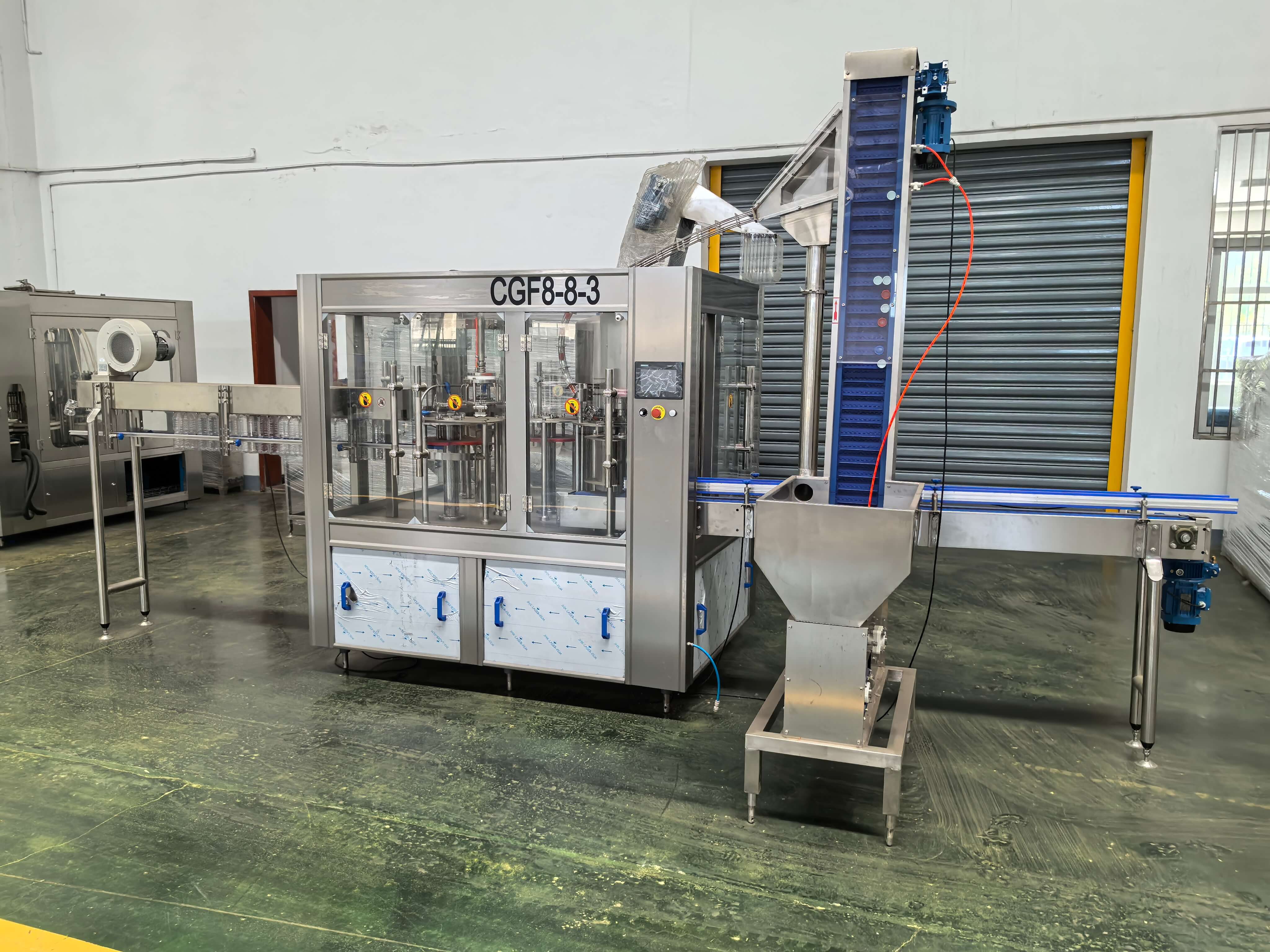
Conveyors are frequently underestimated contributors to lost output. Insufficient buffer length, poorly tuned speed differentials, or excessive back pressure can restrict line performance well below mechanical limits. By reconfiguring accumulation tables and optimizing conveyor zoning, it is often possible to unlock latent capacity without touching core process machines.
Modern low-friction materials and intelligent drive systems allow higher container speeds with reduced instability, particularly for lightweight PET bottles. These changes, though visually subtle, can yield disproportionate gains.
Synchronization Across Machines
As line speeds increase, synchronization tolerance decreases. Labelers, packers, and palletizers must operate within tighter timing windows, making legacy control logic a potential liability. Updating PLC programs to support adaptive speed matching—rather than fixed ratios—can stabilize output at elevated rates.
Such software-level upgrades, while less visible than new hardware, frequently define the success or failure of high-output retrofits.
Filler Optimization Without Full Replacement
Valve Technology and Filling Precision
In many cases, the existing filler can be upgraded internally. Replacing mechanical filling valves with more responsive designs, or retrofitting electronic flow control, improves cycle times without compromising fill accuracy. For mineral water applications, where foaming is typically minimal, these adjustments are especially effective.
Attention must be paid to hygienic integrity during such modifications. Any increase in speed that undermines CIP effectiveness is counterproductive, regardless of theoretical output gains.
Changeover Efficiency as a Throughput Lever
Output is not solely a function of running speed. Frequent format changes, common in diversified product portfolios, erode available production time. Introducing tool-less change parts, standardized container finishes, or automated height adjustments can significantly increase net output over a production week.
This is an area where equipment suppliers like BottlingMachinery often emphasize retrofit kits rather than wholesale replacement, aligning technical improvement with operational reality.
Upstream and Downstream Capacity Alignment
Bottle Supply and Air Systems
For lines using in-house blow molding, air pressure stability and mold cooling efficiency become critical as speeds rise. Compressors sized for original output may struggle at higher duty cycles, leading to pressure drops that cascade into filler starvation.
Even where preforms are outsourced, air conveyors must be assessed. Increased airflow requirements can exceed blower capacity, resulting in bottle instability or jams—issues that manifest only after speed increases are attempted.
Packaging and End-of-Line Constraints
Downstream packaging is a common choke point. Shrink wrappers and palletizers, particularly older models, may lack the mechanical stiffness or control resolution needed for higher speeds. Partial automation upgrades—such as adding robotic palletizing to replace manual stacking—often yield immediate output gains while reducing labor dependency.
Crucially, these upgrades should be evaluated not in isolation but in relation to the filler’s sustained output, lest new imbalances be introduced.
Automation, Data, and Predictive Control
Real-Time Performance Monitoring
As output targets increase, the margin for unplanned downtime narrows. Implementing real-time OEE monitoring allows operators to identify recurring loss patterns that would otherwise remain anecdotal. Data-driven interventions tend to outperform intuition once line complexity crosses a certain threshold.
Sensors monitoring torque, vibration, and temperature can feed predictive maintenance models, reducing catastrophic failures that disproportionately affect high-speed operations.
Control Architecture Modernization
Legacy control systems may lack the processing capacity or communication protocols required for advanced automation. Migrating to unified control platforms enables faster fault recovery and smoother ramp-up to higher speeds. While such upgrades demand careful validation, their long-term impact on line stability is substantial.
Interestingly, many lines fail to reach higher output not due to mechanical weakness, but because control systems cannot respond quickly enough to transient disturbances.
Regulatory and Quality Considerations at Higher Speeds
Increasing output invariably amplifies regulatory risk. Fill-level compliance, cap integrity, and traceability requirements become harder to maintain as tolerances tighten. Inspection systems—vision cameras, leak detectors—must therefore be evaluated alongside speed upgrades.
Neglecting this aspect can result in higher rejection rates that negate nominal output gains, or worse, in compliance failures that interrupt production entirely.
Phased Implementation and Risk Management
Upgrading an existing mineral water bottling line is rarely a single event. Phased implementation allows performance validation at each step, reducing operational risk. Temporary speed increases, supported by enhanced monitoring, provide empirical data that informs subsequent investments.
This approach also facilitates internal alignment. Operations, maintenance, and quality teams are more likely to support upgrades whose benefits are demonstrated incrementally rather than promised abstractly.
While suppliers such as BottlingMachinery may offer comprehensive upgrade roadmaps, the most successful projects remain those grounded in site-specific data and pragmatic execution, rather than generic capacity targets.
Strategic Perspective on Output Growth
Higher output is not an end in itself. It is a response to market signals, cost structures, and competitive dynamics. Upgrading a bottling line should therefore be framed as a strategic initiative, one that balances mechanical capability with organizational readiness.
Where this balance is achieved, output increases follow naturally. Where it is ignored, even the most sophisticated equipment may underperform, quietly constrained by factors no speed dial can address, sometims in ways that only become apparent after substantial investment.