What is the difference between a bottled water filler and a full bottling line?
Water packaging operations range from compact installations supplying local markets to integrated systems serving multinational distribution networks. Within this spectrum, the distinction between a bottled water filler and a full bottling line is often blurred in casual discussion, despite the two occupying clearly different technical and operational roles.
Functional Scope and System Boundaries
A bottled water filler refers specifically to the machine—or modular unit—responsible for dispensing treated water into containers at a controlled volume and flow rate. Its functional boundary is narrow by design: it neither creates the container nor prepares it beyond the immediate requirements of filling. In contrast, a full bottling line encompasses a coordinated sequence of machines that begins upstream of filling and extends downstream into secondary packaging, with the filler acting as only one node within a much broader system.
Where a filler may be described by parameters such as valve type, filling accuracy, and hygienic class, a complete line is instead characterized by throughput balance, line efficiency, and integration logic. The difference is not merely one of scale, but of system thinking.
Mechanical Architecture and Integration Level
Bottled Water Filler as a Standalone Unit
Structurally, a bottled water filler is designed for flexibility. It may be gravity-fed or pressure-based, rotary or linear, and configured for PET, glass, or occasionally HDPE containers. Its mechanical interfaces—container infeed starwheels, discharge conveyors—are standardized to allow installation within varied plant layouts.
Because it operates independently, a filler often relies on external equipment for bottle supply and removal. Operators may manually place containers, or a simple conveyor may deliver pre-formed bottles. The machine’s PLC logic is correspondingly limited, focusing on valve actuation, CIP cycles, and fault detection local to the filling zone.
Full Bottling Line as an Interdependent System
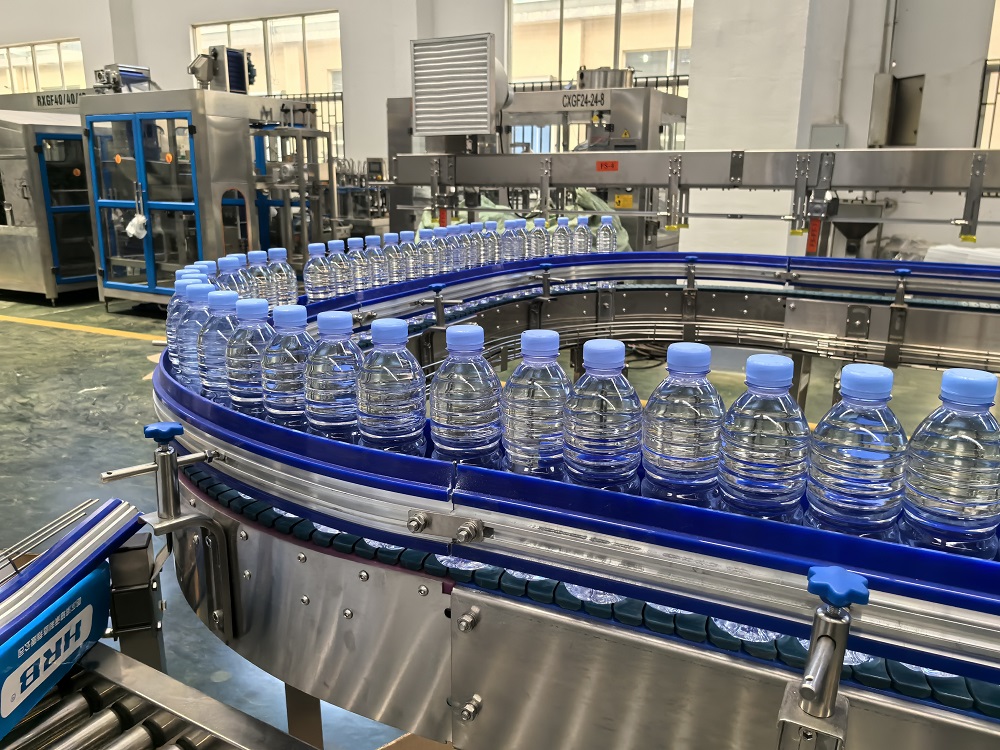
A full bottling line, by contrast, is architected as an interdependent chain. Blow molders, rinser–filler–capper monoblocks, labelers, date coders, shrink wrappers, and palletizers are synchronized through shared control architecture. A stoppage in one section propagates—sometimes deliberately, sometimes not—through the entire line.
Mechanical design choices therefore prioritize compatibility rather than autonomy. Conveyors are engineered with accumulation zones, buffer tables are calculated to absorb micro-stoppages, and changeover mechanisms are aligned across machines to minimize downtime. It is in this context that suppliers such as BottlingMachinery position themselves less as equipment vendors and more as system integrators, although the filler itself remains a discrete mechanical entity.
Hygienic Design and Process Control
Hygiene Focus at the Filling Point
At the filler level, hygienic design concentrates on product-contact surfaces, valve geometry, and cleanability. Stainless steel grades, surface roughness, and seal materials are selected to withstand frequent CIP and SIP routines. The risk profile is localized: contamination introduced at the filler directly affects product safety.
Advanced fillers may incorporate laminar flow hoods, HEPA filtration, and positive-pressure enclosures, yet these features are optional and application-specific. Their inclusion does not, on its own, transform a filler into a full line.
Line-Wide Hygiene Management
In a complete bottling line, hygiene becomes systemic. Bottle blowing introduces its own contamination vectors, while downstream labeling and packing—though technically “dry” processes—must be managed to prevent ingress into the filling zone. Air handling, zoning, and personnel flow are designed holistically.
Notably, quality control data is aggregated across the line. Fill-level deviations, cap torque measurements, and rejection statistics are analyzed together, allowing correlations that would be invisible when observing a filler in isolation.
Operational Complexity and Staffing Requirements
A bottled water filler can often be operated by a small team, sometimes a single trained technician, particularly in low- to mid-speed applications. Maintenance tasks are similarly bounded: valve replacement, seal inspection, sensor calibration.
Full bottling lines, however, demand multidisciplinary oversight. Mechanical, electrical, and automation specialists may all be involved, and production planning becomes inseparable from maintenance scheduling. The operational burden increases nonlinearly; doubling line speed does not merely double complexity, it multiplies it.
It is here that misconceptions frequently arise. A high-speed filler does not imply a high-capacity line unless upstream and downstream equipment are engineered to match—a point occasionally overlooked during plant expansions.
Capital Investment and Scalability
From a financial perspective, a bottled water filler represents a targeted investment. It allows producers to upgrade filling accuracy, hygiene, or speed without committing to a complete overhaul. Such machines are often selected with future integration in mind, their control systems left deliberately open-ended.
A full bottling line, by necessity, involves higher capital expenditure and longer commissioning periods. Its value proposition lies in efficiency at scale: lower cost per unit, reduced labor intensity, and consistent output. Scalability, while possible, is constrained by the weakest link; upgrading one machine may require adjustments across the line, a reality that can complicate long-term planning.
Typical Use Cases in the Industry
Smaller producers, contract packers, and pilot facilities frequently rely on standalone fillers, pairing them with semi-automatic or even manual auxiliary processes. This configuration favors adaptability over raw throughput and suits markets where SKU variability outweighs volume.
Large-scale bottled water brands, conversely, operate full bottling lines not as isolated assets but as nodes within a network of plants. Line standardization across sites enables shared spare parts inventories and harmonized training, benefits that cannot be realized through fillers alone.
Interestingly, hybrid configurations are not uncommon. A facility may run multiple fillers—each dedicated to a container format—feeding into shared labeling and packing sections, blurring the conceptual boundary while preserving the technical distinction.
Decision Criteria Beyond Equipment Lists
Choosing between a bottled water filler and a full bottling line is rarely a purely technical decision. Market volatility, regulatory requirements, and even corporate risk tolerance play roles. Where demand forecasts are uncertain, modularity is prized; where supply contracts are fixed and volumes guaranteed, integration becomes attractive.
What remains constant is the underlying difference in intent. A filler is a machine optimized for a specific task, elegant in its focus. A full bottling line is an industrial system, messy at times, yet powerful in its coordination. Confusing the two may not halt production, but it does obscure the strategic implications embedded in each choice, sometmes at considerable cost.